When Chevrolet introduced the Corvette in 1953, hardcore motorsport
enthusiasts rejoiced at the idea of a home-grown sports car. But
soon, the Corvette became somewhat compromised as GM prioritized
style over outright performance to boost sales. Even as sales
struggled and GM threatened to pull the plug on the program, plans
for a more focused, purposeful Corvette began as early as 1957. It
took considerable effort by a passionate team of engineers led by
Zora Arkus-Duntov to convince the GM board to allow the program to
continue, but thankfully, the Corvette received a stay of
execution. In 1963, Chevrolet introduced a completely new
second-generation Corvette. Essential elements of the experimental
Q-Corvette and Sting Ray dream car combined to form the most
sophisticated and stylish Corvette yet. Duntov and his team
revolutionized the Corvette, ditching its family sedan
underpinnings once and for all and finally giving GM a proper,
no-excuses sports car to take on the Europeans. The new
purpose-built chassis featured four-wheel independent suspension,
big drum brakes (discs followed soon after), and various iterations
of the 327-cubic-inch small-block V-8 ranging from the
250-horsepower base engine to an impressive 360-horsepower version
with the optional L-84 package, comprised of a Duntov camshaft,
solid lifters, and RochesterRam Jet mechanical fuel injection. Atop
the advanced chassis sat a stunning new body designed by the great
Larry Shinoda under the direction of GM design boss Bill Mitchell.
The design set the automotive world alight with its gorgeous
boat-tail fastback roofline, rear split window, pronounced fender
bulges, and an aggressive, purposeful stance. The C2 Corvette
remains one of the most iconic and beloved American car designs.
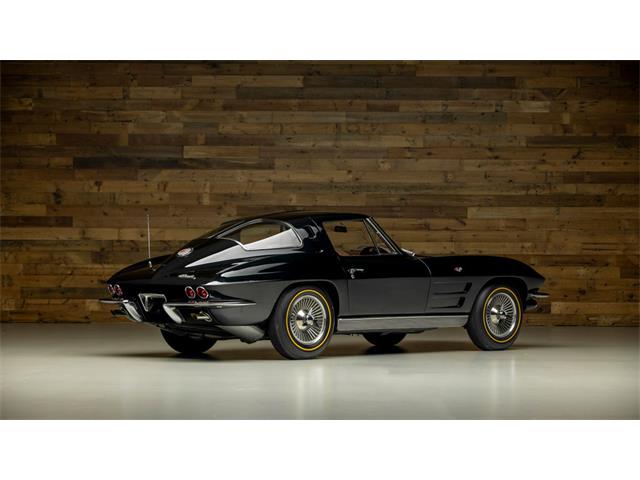
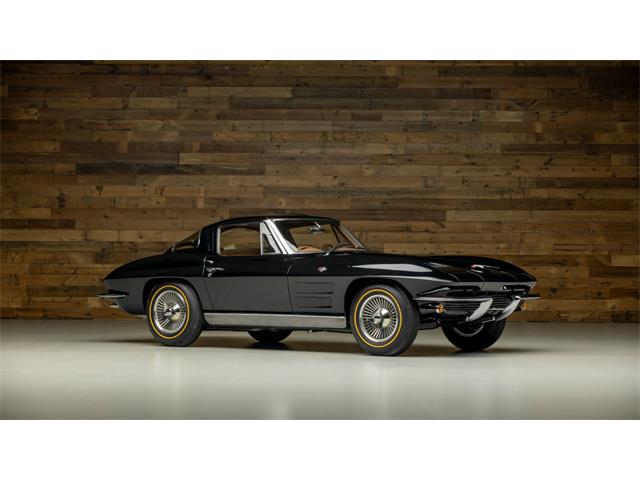
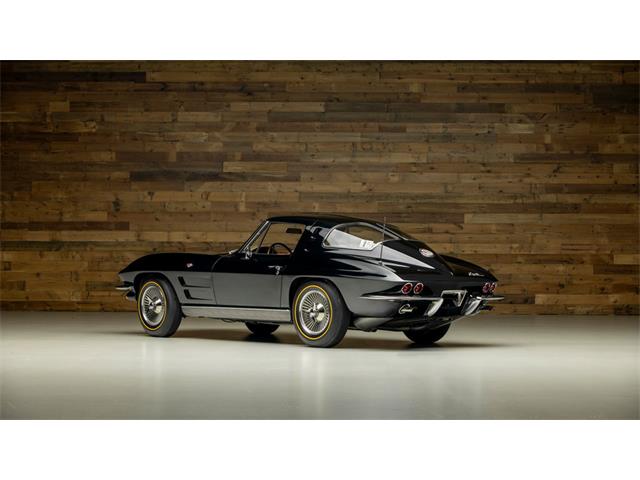
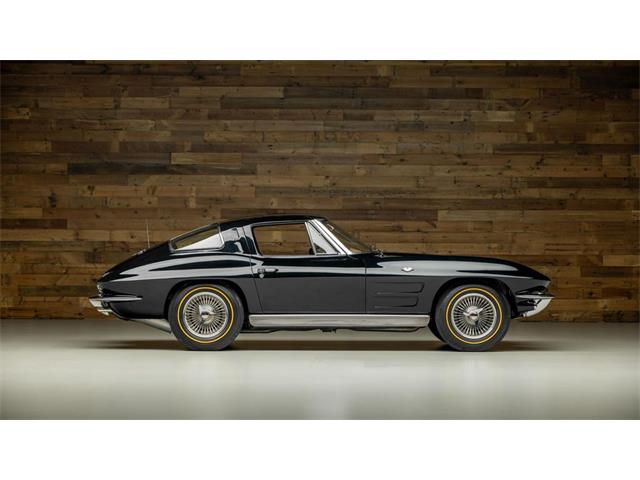
This highly desirable 1963 Corvette Split-Window Coupe is equipped
with the high-performance, 327-cubic-inch, RE-code 340-HP engine
with Carter four-barrel carburetor. This is the highest horsepower
engine offered before the 360-HP fuel-injected engine. Many
enthusiasts prefer the simple-to-tune and user friendly 340-HP cars
over the sometimes fickle and complex fuel-injected cars, making
this car highly desirable for those who enjoy driving their
Corvettes. The tidy engine bay is authentically detailed and
accurate to the period, including the correct 340-HP air cleaner.
It runs and drives well, and with 340 horsepower on tap, a factory
3.70 limited-slip rear differential, and a Muncie four-speed
gearbox, punchy performance off the line and instant acceleration
in all four gears are assured. Finished elegantly in Tuxedo Black,
this Corvette is authentically detailed with correct badges, body
fittings, and trim. The body fit is excellent, and the finish
quality is excellent overall, with a glossy finish. Rolling stock
consists of correct-style knock-off styled wheels fitted with 7.75
Gold Line-15-inch BFGoodrich tires that stand out against the deep
black body color. As with the bodywork, the interior is in its
original specifications with correct saddle vinyl upholstery,
saddle carpets, and proper fittings, including the three-spoke
woodgrain steering wheel, T-handle four-speed shifter with black
gear-shift knob, optional power windows and early model Delco
signal-seeking radio. The soft trim and interior fittings are in
excellent condition throughout the cockpit. The Split
Windowrepresents the ultimate Corvette for many enthusiasts and
collectors, combining rarity, beauty, and uncompromised
performance. This example, in striking Tuxedo Black and fitted with
the ultra desirable 340-horsepower engine and four-speed manual
transmission, is a quintessential American icon. * Iconic
one-year-only 'split-window' coupe
* Desirable 340-HP, 327-cubic-inch V-8 engine
* Equipped with Muncie four-speed transmission
* Knock-off styled wheels with Gold Stripe tires
* Features power windows
When Chevrolet introduced the Corvette in 1953, hardcore motorsport
enthusiasts rejoiced at the idea of a home-grown sports car. But
soon, the Corvette became somewhat compromised as GM prioritized
style over outright performance to boost sales. Even as sales
struggled and GM threatened to pull the plug on the program, plans
for a more focused, purposeful Corvette began as early as 1957. It
took considerable effort by a passionate team of engineers led by
Zora Arkus-Duntov to convince the GM board to allow the program to
continue, but thankfully, the Corvette received a stay of
execution.
In 1963, Chevrolet introduced a completely new second-generation
Corvette. Essential elements of the experimental Q-Corvette and
Sting Ray dream car combined to form the most sophisticated and
stylish Corvette yet. Duntov and his team revolutionized the
Corvette, ditching its family sedan underpinnings once and for all
and finally giving GM a proper, no-excuses sports car to take on
the Europeans. The new purpose-built chassis featured four-wheel
independent suspension, big drum brakes (discs followed soon
after), and various iterations of the 327-cubic-inch small-block
V-8 ranging from the 250-horsepower base engine to an impressive
360-horsepower version with the optional L-84 package, comprised of
a Duntov camshaft, solid lifters, and Rochester Ram Jet mechanical
fuel injection. Atop the advanced chassis sat a stunning new body
designed by the great Larry Shinoda under the direction of GM
design boss Bill Mitchell. The design set the automotive world
alight with its gorgeous boat-tail fastback roofline, rear split
window, pronounced fender bulges, and an aggressive, purposeful
stance. The C2 Corvette remains one of the most iconic and beloved
American car designs.
This highly desirable 1963 Corvette Split-Window Coupe is equipped
with the high-performance, 327-cubic-inch, RE-code 340-HP engine
with Carter four-barrel carburetor. This is the highest horsepower
engine offered before the 360-HP fuel-injected engine. Many
enthusiasts prefer the simple-to-tune and user friendly 340-HP cars
over the sometimes fickle and complex fuel-injected cars, making
this car highly desirable for those who enjoy driving their
Corvettes.
The tidy engine bay is authentically detailed and accurate to the
period, including the correct 340-HP air cleaner. It runs and
drives well, and with 340 horsepower on tap, a factory 3.70
limited-slip rear differential, and a Muncie four-speed gearbox,
punchy performance off the line and instant acceleration in all
four gears are assured.
Finished elegantly in Tuxedo Black, this Corvette is authentically
detailed with correct badges, body fittings, and trim. The body fit
is excellent, and the finish quality is excellent overall, with a
glossy finish. Rolling stock consists of correct-style knock-off
styled wheels fitted with 7.75 Gold Line-15-inch BFGoodrich tires
that stand out against the deep black body color. As with the
bodywork, the interior is in its original specifications with
correct saddle vinyl upholstery, saddle carpets, and proper
fittings, including the three-spoke woodgrain steering wheel,
T-handle four-speed shifter with black gear-shift knob, optional
power windows and early model Delco signal-seeking radio. The soft
trim and interior fittings are in excellent condition throughout
the cockpit.
The Split Window represents the ultimate Corvette for many
enthusiasts and collectors, combining rarity, beauty, and
uncompromised performance. This example, in striking Tuxedo Black
and fitted with the ultra desirable 340-horsepower engine and
four-speed manual transmission, is a quintessential American icon.
ClassicCars.com has been recognized as one of the fastest-growing private companies in the United States, successfully making the Inc. 5000 list in both 2015,
2016, 2017 and 2018. This prestigious accolade represents the continued growth of the company, and ClassicCars.com's dominance as the world's largest online marketplace for
buying and selling classic and collector vehicles.
The Stevie Awards, the world's premier business awards recognized
ClassicCars.com's first-class Customer Support team with a Stevie Bronze Award in 2019, celebrating the team's skills as exemplary customer support specialists.
In 2016 The Journal, brought to you by ClassicCars.com, was celebrated as the SECOND MOST INFLUENTIAL automotive blog in the world by NFC Performance.