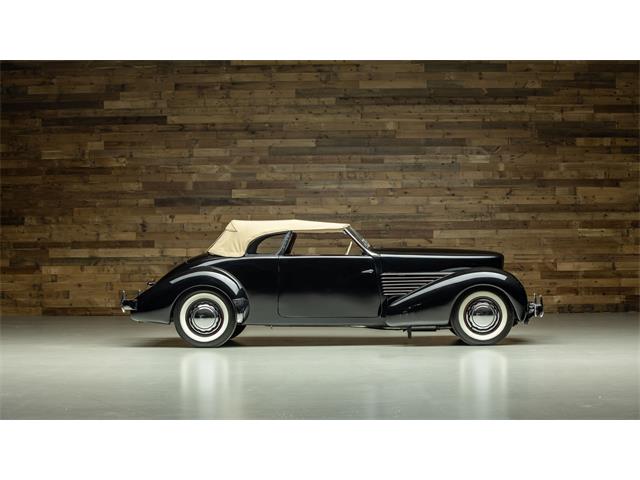
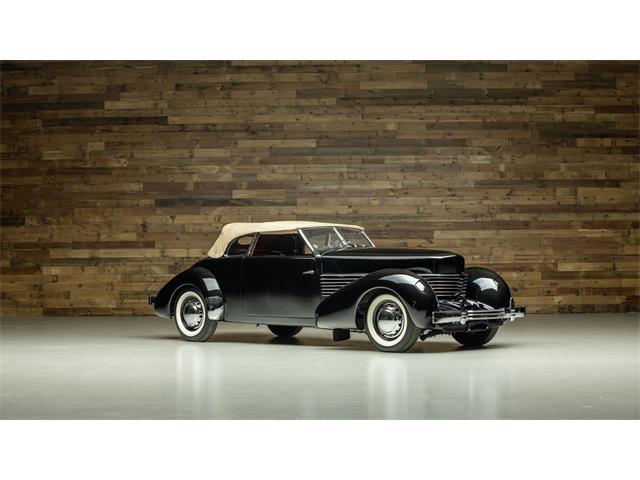
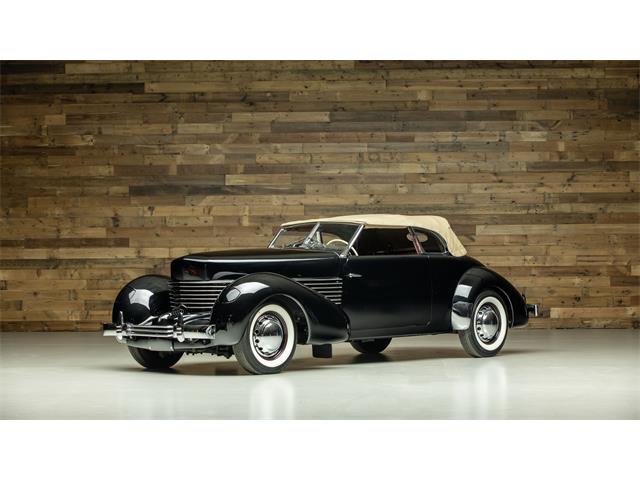
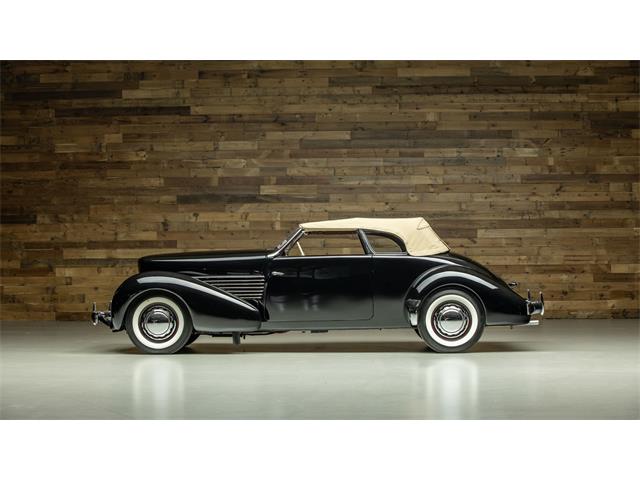
Chassis No: 2041H One of the few automobiles deemed worthy of
inclusion in the Museum of Modern Art in New York and arguably the
most easily recognized American car of all time, the Cord 810
debuted in November 1935, receiving a rapturous reception at U.S.
automobile shows. The work of a team headed by Duesenberg Designer
Gordon Buehrig, the 810 body style with a louvred 'coffin' nose,
streamlined, spat-shaped wings and absence of running boards would
prove immensely influential; its distinctive features were borrowed
by most mainstream manufacturers by the decade's end. The 810's
arrival marked the end of a hiatus in Cord production, with its
predecessor, the L-29, having disappeared in 1931. Errett Lobban
Cord had introduced the latter in 1929 as a gap-filling model
priced between his Cord Corporation's Auburn and Duesenberg lines.
Powered by a Lycoming straight eight, the Cord L-29 featured
front-wheel drive, a chassis layout then in vogue at Indianapolis.
Its front-drive layout made for a low-slung frame, and the freedom
this gave coachbuilders meant that the Cord was soon attracting the
attention of master craftsmen on both sides of the Atlantic. A
front-wheel-drive car like the L-29, the 810 differed from its
predecessor by virtue of its more compact Lycoming V-8 engine and
four-speed, pre-selector gearbox. Set further back in the chassis,
the former endowed the 810 with better balance and came with 125bhp
in standard trim or 170bhp when supercharged. Custom sedans on a
longer wheelbase joined the four-model 812 range for 1937. Priced
competitively in the $2,000-3,000 range, the 810/812 should have
been a huge success, though, sadly, this was not to be. The Cord
Corporation was in deep financial trouble, and when its proprietor
sold up in August 1937, it spelled the end not just for Cord, but
for Auburn and Duesenberg as well. At the close, a little fewer
than 3,000 810/812s had been made. This stunning 1936 Cord 810
Phaeton is believed to be a very early production Cord 810, with a
windshield frame cast in bronze. Cord experts believe only the
first ten cars produced were fitted with a bronze windshield frame
before switching to a cast metal frame. Recognizing the importance
of this historically significant Cord, the current owner
commissioned a comprehensive restoration. The authentic and quality
restoration was performed by renowned Cord specialist Jim O'Brien
of Redding, Pennsylvania, and done to the highest standard. The
black paint was polished to a mirror gloss over an arrow-straight
body. The interior, trim, chrome, glass and more have been restored
to concours quality. Mechanical components have been fully sorted,
making this classic a pleasure to drive. The fresh restoration was
completed in January of 2026. A certification from the ACD Club
authenticating the car was issued in 2025 and accompanies the car.
This rare Cord has yet to be shown, presenting an opportunity for
the next owner to exhibit it at Auburn-Cord-Duesenberg meets,
Classic Car Club of America events and Concours d'Elegance shows
both in America and overseas. Unquestionably one of the most
distinctive designs ever to grace an automobile, this rare,
early-production Cord 810 Phaeton is ready to be enjoyed and
treasured by its next owner. * ACD Club Certified C-493
* Believed to be one of the first ten Cord 810s produced as
equipped with its bronze windshield frame
* Comprehensive restoration by marque specialist Jim O'Brien
completed in January 2026
* Art Deco styling with impressive eight-cylinder power
* Eligible for CCCA, ACD Club, and various other collector car
events
Chassis No: 2041H
One of the few automobiles deemed worthy of inclusion in the Museum
of Modern Art in New York and arguably the most easily recognized
American car of all time, the Cord 810 debuted in November 1935,
receiving a rapturous reception at U.S. automobile shows. The work
of a team headed by Duesenberg Designer Gordon Buehrig, the 810
body style with a louvred 'coffin' nose, streamlined, spat-shaped
wings and absence of running boards would prove immensely
influential; its distinctive features were borrowed by most
mainstream manufacturers by the decade's end.
The 810's arrival marked the end of a hiatus in Cord production,
with its predecessor, the L-29, having disappeared in 1931. Errett
Lobban Cord had introduced the latter in 1929 as a gap-filling
model priced between his Cord Corporation's Auburn and Duesenberg
lines. Powered by a Lycoming straight eight, the Cord L-29 featured
front-wheel drive, a chassis layout then in vogue at Indianapolis.
Its front-drive layout made for a low-slung frame, and the freedom
this gave coachbuilders meant that the Cord was soon attracting the
attention of master craftsmen on both sides of the Atlantic.
A front-wheel-drive car like the L-29, the 810 differed from its
predecessor by virtue of its more compact Lycoming V-8 engine and
four-speed, pre-selector gearbox. Set further back in the chassis,
the former endowed the 810 with better balance and came with 125bhp
in standard trim or 170bhp when supercharged. Custom sedans on a
longer wheelbase joined the four-model 812 range for 1937.
Priced competitively in the $2,000-3,000 range, the 810/812 should
have been a huge success, though, sadly, this was not to be. The
Cord Corporation was in deep financial trouble, and when its
proprietor sold up in August 1937, it spelled the end not just for
Cord, but for Auburn and Duesenberg as well. At the close, a little
fewer than 3,000 810/812s had been made.
This stunning 1936 Cord 810 Phaeton is believed to be a very early
production Cord 810, with a windshield frame cast in bronze. Cord
experts believe only the first ten cars produced were fitted with a
bronze windshield frame before switching to a cast metal frame.
Recognizing the importance of this historically significant Cord,
the current owner commissioned a comprehensive restoration. The
authentic and quality restoration was performed by renowned Cord
specialist Jim O'Brien of Redding, Pennsylvania, and done to the
highest standard. The black paint was polished to a mirror gloss
over an arrow-straight body. The interior, trim, chrome, glass and
more have been restored to concours quality. Mechanical components
have been fully sorted, making this classic a pleasure to drive.
The fresh restoration was completed in January of 2026. A
certification from the ACD Club authenticating the car was issued
in 2025 and accompanies the car. This rare Cord has yet to be
shown, presenting an opportunity for the next owner to exhibit it
at Auburn-Cord-Duesenberg meets, Classic Car Club of America events
and Concours d'Elegance shows both in America and overseas.
Unquestionably one of the most distinctive designs ever to grace an
automobile, this rare, early-production Cord 810 Phaeton is ready
to be enjoyed and treasured by its next owner.
ClassicCars.com has been recognized as one of the fastest-growing private companies in the United States, successfully making the Inc. 5000 list in both 2015,
2016, 2017 and 2018. This prestigious accolade represents the continued growth of the company, and ClassicCars.com's dominance as the world's largest online marketplace for
buying and selling classic and collector vehicles.
The Stevie Awards, the world's premier business awards recognized
ClassicCars.com's first-class Customer Support team with a Stevie Bronze Award in 2019, celebrating the team's skills as exemplary customer support specialists.
In 2016 The Journal, brought to you by ClassicCars.com, was celebrated as the SECOND MOST INFLUENTIAL automotive blog in the world by NFC Performance.