They say all good things must come to an end and such it was for
the second generation of America's Sports Cars, the Corvette
Stingray. Starting in 1958, Ed Cole, by then the General Manager
for all things Chevrolet, created the "Q-Corvette" team. These
would evolve into what are today known as the "C2" Corvettes.
Cole's team focused on development of a better handling chassis
that would incorporate four-wheel independent suspension,
eventually have disc brakes on all four wheels, better weight
distribution along with other revolutionary ideas. For outside
beauty, GM's Director of Styling, Bill Mitchell, who had succeeded
Harley Earl in the latter part of the 1950s, had attended the Turin
Auto Show in Italy where he had become fascinated by the Alfa Romeo
C52 Disco Volante experimental coupe and roadster. He brought back
to his "Studio X" in the basement of the General Motors Tech center
in Warren, Michigan, hundreds of photos and notes where his
talented team of stylists could work their magic. As early as the
1961 model year, hints of Mitchell's ideas started to materialize
on production Corvettes and with the completely redesigned 1963
Stingray, it was "game on". No other production car, American or
otherwise had the flair and style as the new Corvettes. For five
years, these cars were the envy of millions of gear-head driven
youths. Improvements in performance and handling were constant
goals under Ed Cole and Mitchell's teams created facelifts that
freshened that original creation. For 1967, Chevrolet build these
models as "the Corvette for the thinking driver" and many experts
agreed with that statement and considered that in base form, with
the 300-HP, 327-cid V-8, it was the perfect real-world Sport-GT
car. Considered by many critics and owners, 1967s were the best C2
Stingrays, as they were now equipped with the four-wheel disc
brakes Ed Cole had campaigned for, and stability was improved was
with wider, more road-gripping tires and more efficient wheels.
Construction quality was at is zenith this season with superior
body quality and exterior finishes. For real motoring enthusiasts,
many consider the 300-HP version of the 327 to be a perfect blend
of performance, handling and style, sort of a sweet spot where all
the elements of a sports car combined. There were bigger
displacement engines with lots more horsepower, but this base model
was still able to pull 16-second quarter-mile runs and go from 0 to
60 MPH in just 7.8 seconds. This wonderfully fascinating 1967
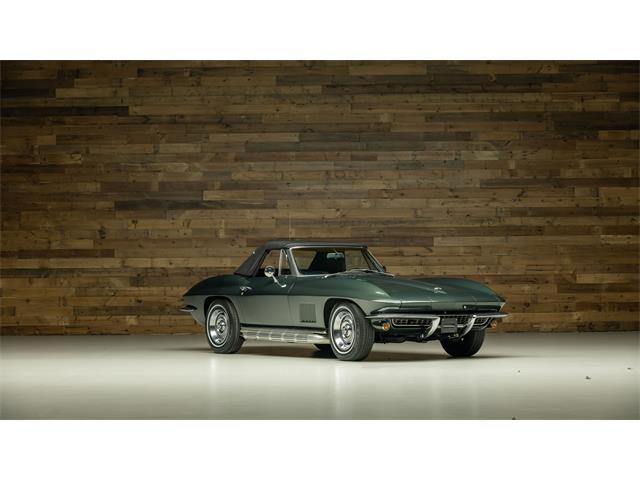
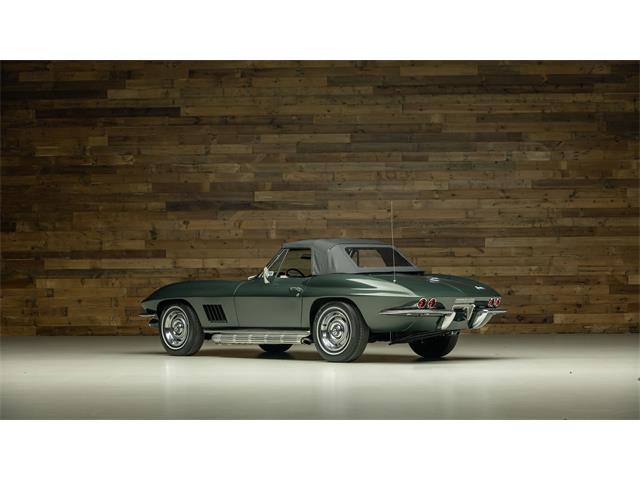
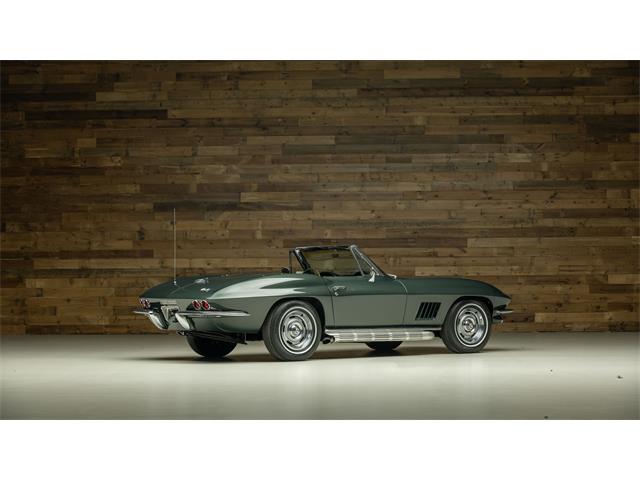
327/300 Corvette convertible has lived a good life. This Stingray
is not a trailer queen nor is it a contender for any special
recognition in critical judged events. But what it is, is a
driver's delight. Well-maintained and looking quite handsome in its
original color of Goodwood Green, this awesome machine is powered
by a 300-HP, 327-cubic-inch small-block V-8 and backed up with a
four-speed transmission. Its interior shows signs of this being a
veteran of the open road; used, but not abused. While the odometer
shows just under 38,950 miles, its true mileage is unknown, and at
some point, the original engine was replaced with a substitute
block. It does have four-wheel disc brakes and is fitted with a set
of attractive rally wheels while riding on Nexen 205/175R15
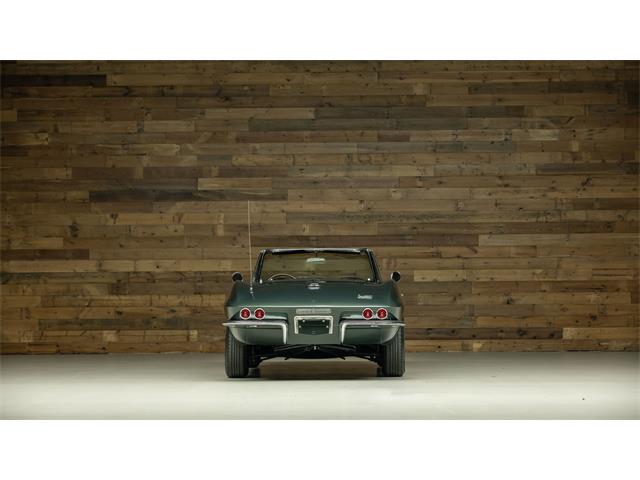
blackwall tires. Cosmetically, this convertible presents a pretty
picture with no flaws noted in the bodywork, a paint finish that is
smooth and was professionally applied,. The interior appears to be
quite original and features correct interior appointments, such as
the instruments and Delco AM-FM radio, which remain in place. Ready
for any weather, the black folding top which can be raised or
lowered with little effort. Best of all is that powerful rumble
from that well-tuned engine that resonates through the side-mounted
exhaust pipes. For someone who is looking for a clean, fun-to-drive
V-8-powered sports car, someone who fits the bill for being a
"thinking driver" and who is looking for enjoyment on the open
road, this is a rare find that has it all, except you behind the
steering wheel. This can be remedied with the right bid. 300-HP,
327-cid V-8 engine that many consider the pinnacle for
drivability
Finished in original Goodwood Green with black vinyl seats and
black top
Fresh radial blackwall tires on beautiful rally wheels
A delightful and drivable Corvette convertible
They say all good things must come to an end and such it was for
the second generation of America's Sports Cars, the Corvette
Stingray. Starting in 1958, Ed Cole, by then the General Manager
for all things Chevrolet, created the "Q-Corvette" team. These
would evolve into what are today known as the "C2" Corvettes.
Cole's team focused on development of a better handling chassis
that would incorporate four-wheel independent suspension,
eventually have disc brakes on all four wheels, better weight
distribution along with other revolutionary ideas. For outside
beauty, GM's Director of Styling, Bill Mitchell, who had succeeded
Harley Earl in the latter part of the 1950s, had attended the Turin
Auto Show in Italy where he had become fascinated by the Alfa Romeo
C52 Disco Volante experimental coupe and roadster. He brought back
to his "Studio X" in the basement of the General Motors Tech center
in Warren, Michigan, hundreds of photos and notes where his
talented team of stylists could work their magic. As early as the
1961 model year, hints of Mitchell's ideas started to materialize
on production Corvettes and with the completely redesigned 1963
Stingray, it was 'game on'. No other production car, American or
otherwise had the flair and style as the new Corvettes. For five
years, these cars were the envy of millions of gear-head driven
youths. Improvements in performance and handling were constant
goals under Ed Cole and Mitchell's teams created facelifts that
freshened that original creation. For 1967, Chevrolet build these
models as "the Corvette for the thinking driver" and many experts
agreed with that statement and considered that in base form, with
the 300-HP, 327-cid V-8, it was the perfect real-world Sport-GT
car. Considered by many critics and owners, 1967s were the best C2
Stingrays, as they were now equipped with the four-wheel disc
brakes Ed Cole had campaigned for, and stability was improved was
with wider, more road-gripping tires and more efficient wheels.
Construction quality was at is zenith this season with superior
body quality and exterior finishes. For real motoring enthusiasts,
many consider the 300-HP version of the 327 to be a perfect blend
of performance, handling and style, sort of a sweet spot where all
the elements of a sports car combined. There were bigger
displacement engines with lots more horsepower, but this base model
was still able to pull 16-second quarter-mile runs and go from 0 to
60 MPH in just 7.8 seconds.
This wonderfully fascinating 1967 327/300 Corvette convertible has
lived a good life. This Stingray is not a trailer queen nor is it a
contender for any special recognition in critical judged events.
But what it is, is a driver's delight. Well-maintained and looking
quite handsome in its original color of Goodwood Green, this
awesome machine is powered by a 300-HP, 327-cubic-inch small-block
V-8 and backed up with a four-speed transmission. Its interior
shows signs of this being a veteran of the open road; used, but not
abused. While the odometer shows just under 38,950 miles, its true
mileage is unknown, and at some point, the original engine was
replaced with a substitute block. It does have four-wheel disc
brakes and is fitted with a set of attractive rally wheels while
riding on Nexen 205/175R15 blackwall tires. Cosmetically, this
convertible present...for more information please contact the
seller.
ClassicCars.com has been recognized as one of the fastest-growing private companies in the United States, successfully making the Inc. 5000 list in both 2015,
2016, 2017 and 2018. This prestigious accolade represents the continued growth of the company, and ClassicCars.com's dominance as the world's largest online marketplace for
buying and selling classic and collector vehicles.
The Stevie Awards, the world's premier business awards recognized
ClassicCars.com's first-class Customer Support team with a Stevie Bronze Award in 2019, celebrating the team's skills as exemplary customer support specialists.
In 2016 The Journal, brought to you by ClassicCars.com, was celebrated as the SECOND MOST INFLUENTIAL automotive blog in the world by NFC Performance.