This vehicle has been soldThis vehicle is no longer available for sale on ClassicCars.com. Please set an alert if you would like to be notified as soon as similar vehicles become available.
For Sale at Auction: 1947 Ford Sportsman in Auburn, Indiana
The 1947 Ford Sportsman Convertible stands as one of the more
distinctive and desirable expressions of the classic American
"woodie," a body style rooted in the earliest days of automotive
coachbuilding. Originally, wood-bodied automobiles evolved from
horse-drawn "shooting brakes," where hardwood construction formed
the passenger compartments. By the 1930s and early 1940s, American
manufacturers, Ford chief among them, had refined the concept into
stylish station wagons and specialty vehicles that combined utility
with craftsmanship. Following World War II, automakers faced an
eager public but limited resources, often relying on prewar designs
to resume production. To inject excitement into its showrooms, Ford
introduced the Sportsman in 1946 as its only truly new postwar
offering, a glamorous wood-bodied convertible intended to draw
attention and elevate the brand's image. The idea originated with
Henry Ford II, who commissioned designer E. T. Gregorie to create a
stylish, beach-inspired car using traditional wood construction.
The resulting prototype proved so popular that it quickly entered
limited production. The Sportsman's construction was both beautiful
and labor-intensive. Built at Ford's Iron Mountain facility, each
body utilized hand-fitted maple framing with mahogany and birch
panels mounted to a steel structure. This craftsmanship, combined
with upscale features like leather upholstery, power windows, and
Ford's dependable flathead V-8, placed the Sportsman at the very
top of the Super Deluxe range and at a price significantly higher
than a standard convertible. Produced in limited numbers, the 1947
Sportsman remains exceptionally rare today. Its combination of
hand-built artistry, postwar optimism, and exclusivity made it one
of the most coveted automobiles of its era. More than just a car,
the Sportsman represented a return to luxury and leisure in
America, capturing a moment when craftsmanship and style briefly
took center stage before steel construction would ultimately
replace the traditional woodie. According to *The V-8 Album,* the
Early Ford V-8 Club of America official book, this is 1 of just
3,525 Sportsman Convertibles produced over the short three-year
production run. Appearing to be a largely original example, this
Sportsman was a former resident of a noted woodie collection
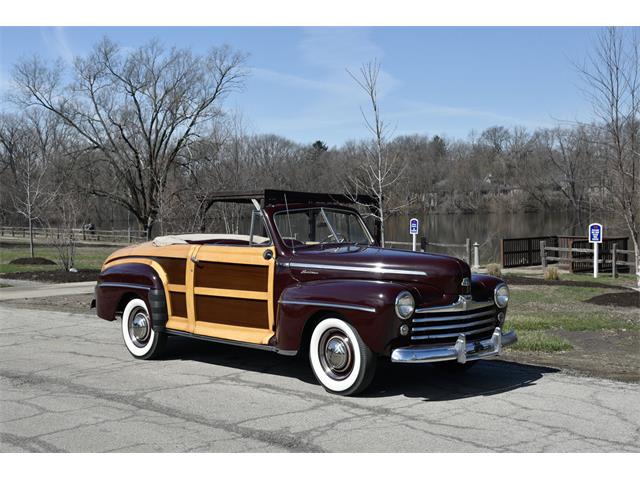
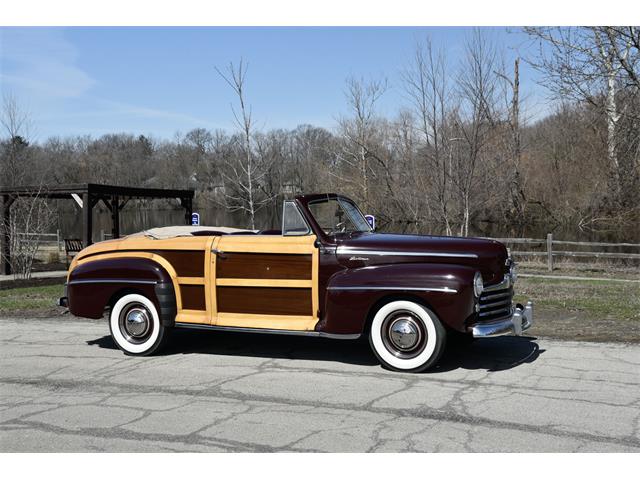
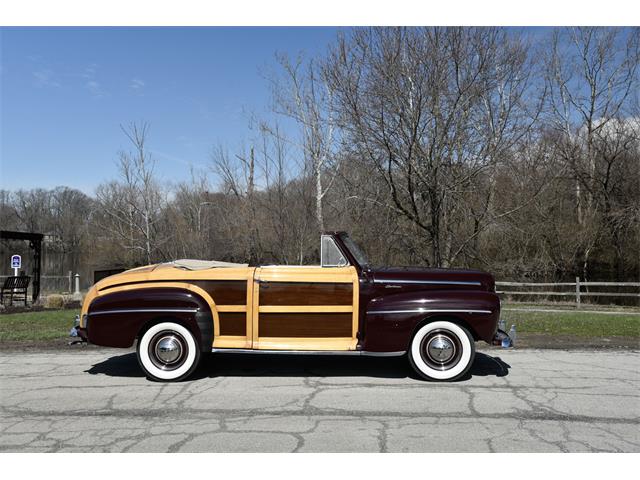
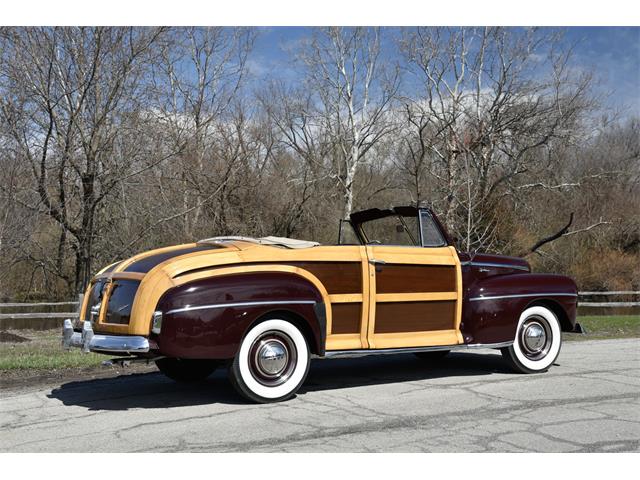
located in New Hampshire. Finished in Garnet Red with nicely
varnished wood paneling, it features a power operated tan Haartz
convertible top, matching boot, a Ford script clamshell exhaust
cover, and Ford script hubcaps with color-matched beauty rings
wrapped in wide whitewall tires. Inside, the Bakelite steering
wheel and dash present well, and features power windows, a clock, a
Philco AM radio, and an under-the-dash heater. Equipped with a
classic 239-cubic-inch flathead V-8 that produces 100 horsepower,
and a three-speed manual transmission, it offers reliable and
sufficient performance for which these flathead engines are known.
One of the more desirable wood-bodied automobiles of both the
prewar and immediate postwar era, this 1947 Ford Sportsman
Convertible offers a unique blend of craftsmanship and open-air
enjoyment and remains a rewarding car to drive and tour. * 1 of
just 3,525 Sportsman Convertibles produced over three years
* Flathead V-8 performance and reliability
* Formerly part of an East Coast woodie collection
* One of the more desirable wood-bodied Fords from the prewar or
postwar era
The 1947 Ford Sportsman Convertible stands as one of the more
distinctive and desirable expressions of the classic American
"woodie," a body style rooted in the earliest days of automotive
coachbuilding. Originally, wood-bodied automobiles evolved from
horse-drawn "shooting brakes," where hardwood construction formed
the passenger compartments. By the 1930s and early 1940s, American
manufacturers, Ford chief among them, had refined the concept into
stylish station wagons and specialty vehicles that combined utility
with craftsmanship.
Following World War II, automakers faced an eager public but
limited resources, often relying on prewar designs to resume
production. To inject excitement into its showrooms, Ford
introduced the Sportsman in 1946 as its only truly new postwar
offering, a glamorous wood-bodied convertible intended to draw
attention and elevate the brand's image. The idea originated with
Henry Ford II, who commissioned designer E. T. Gregorie to create a
stylish, beach-inspired car using traditional wood construction.
The resulting prototype proved so popular that it quickly entered
limited production.
The Sportsman's construction was both beautiful and
labor-intensive. Built at Ford's Iron Mountain facility, each body
utilized hand-fitted maple framing with mahogany and birch panels
mounted to a steel structure. This craftsmanship, combined with
upscale features like leather upholstery, power windows, and Ford's
dependable flathead V-8, placed the Sportsman at the very top of
the Super Deluxe range and at a price significantly higher than a
standard convertible.
Produced in limited numbers, the 1947 Sportsman remains
exceptionally rare today. Its combination of hand-built artistry,
postwar optimism, and exclusivity made it one of the most coveted
automobiles of its era. More than just a car, the Sportsman
represented a return to luxury and leisure in America, capturing a
moment when craftsmanship and style briefly took center stage
before steel construction would ultimately replace the traditional
woodie.
According to *The V-8 Album,* the Early Ford V-8 Club of America
official book, this is 1 of just 3,525 Sportsman Convertibles
produced over the short three-year production run. Appearing to be
a largely original example, this Sportsman was a former resident of
a noted woodie collection located in New Hampshire. Finished in
Garnet Red with nicely varnished wood paneling, it features a power
operated tan Haartz convertible top, matching boot, a Ford script
clamshell exhaust cover, and Ford script hubcaps with color-matched
beauty rings wrapped in wide whitewall tires.
Inside, the Bakelite steering wheel and dash present well, and
features power windows, a clock, a Philco AM radio, and an
under-the-dash heater. Equipped with a classic 239-cubic-inch
flathead V-8 that produces 100 horsepower, and a three-speed manual
transmission, it offers reliable and sufficient performance for
which these flathead engines are known.
One of the more desirable wood-bodied automobiles of both the
prewar and immediate postwar era, this 1947 Ford Sportsman
Convertible offers a unique blend of craftsmanship and open-air
enjoyment and remains a rewarding car to drive and tour.
ClassicCars.com has been recognized as one of the fastest-growing private companies in the United States, successfully making the Inc. 5000 list in both 2015,
2016, 2017 and 2018. This prestigious accolade represents the continued growth of the company, and ClassicCars.com's dominance as the world's largest online marketplace for
buying and selling classic and collector vehicles.
The Stevie Awards, the world's premier business awards recognized
ClassicCars.com's first-class Customer Support team with a Stevie Bronze Award in 2019, celebrating the team's skills as exemplary customer support specialists.
In 2016 The Journal, brought to you by ClassicCars.com, was celebrated as the SECOND MOST INFLUENTIAL automotive blog in the world by NFC Performance.